



Building secure holiday lodges
Installing a holiday lodge should be straightforward. Pick your spot, lay foundations, position the lodge, and you’re done.
Well, it seldom works out that neatly. Traditional concrete foundations mean weeks of digging, concrete lorries struggling down narrow lanes, and permanently damaged landscapes.
To get straight to the point, ground screws eliminate most of these problems. They install in hours rather than weeks, need no excavation, and work immediately – you’re usually set and ready to build within a day!
Whether you’re positioning glamping pods, static caravans, or full-sized timber lodges, ground screws provide stable foundations on sites where concrete is impossible, forbidden by planning authorities, or painfully impractical.
Let’s explore why ground screws suit holiday accommodation so well, and what you need to know before starting your lodge project.
How Holiday Lodges Are Typically Installed on Site
Today, most standard-sized holiday lodges arrive on site as complete or near-complete units.
Timber lodges are partially constructed, static caravans roll in on their chassis, and glamping pods often arrive ready to move into position.
In all cases, the lodge will need foundations. The lodge installation itself isn’t generally the complicated part – it’s the foundations. There are three core options:
Concrete Pad Foundations
The most common method uses individual concrete pads at each support point. You’ll mark out where the lodge needs support, dig holes for each pad (typically 60cm deep or more), add hardcore for drainage, then pour concrete at each location.
The pads need to cure before the lodge can be positioned. The process creates excavation waste at each pad location, requires skip hire for soil removal, and weather can extend timelines if conditions aren’t ideal.
Full Concrete Slab Foundations
For larger or more permanent lodges, some sites use complete concrete slabs under the entire footprint. This involves excavating the whole area, adding hardcore and membrane, building shuttering around the perimeter, then pouring and levelling concrete across the entire base.
Full slabs provide excellent stability and moisture protection, but the process is more involved and expensive. You’re looking at several days of preparation work, then the same lengthy cure time (up to 14 days) before the lodge can be positioned. The excavation creates significant waste, and the concrete is a permanent fixture.
Ground Screw Foundations
Ground screws provide a robust, flexible alternative that eliminates excavation and curing delays entirely.
Installation is rapid – usually one day – with no excavation waste, no concrete curing time, and the lodge can be positioned immediately. The screws adapt to sloped or uneven ground without requiring extensive site preparation, and they can be removed entirely if the lodge needs to be relocated down the line.
For sites with difficult access, slopes, or environmental restrictions, ground screws often prove faster and more cost-effective than concrete methods whilst providing equivalent structural performance.
Holiday Lodges And Concrete – Understanding the Challenges
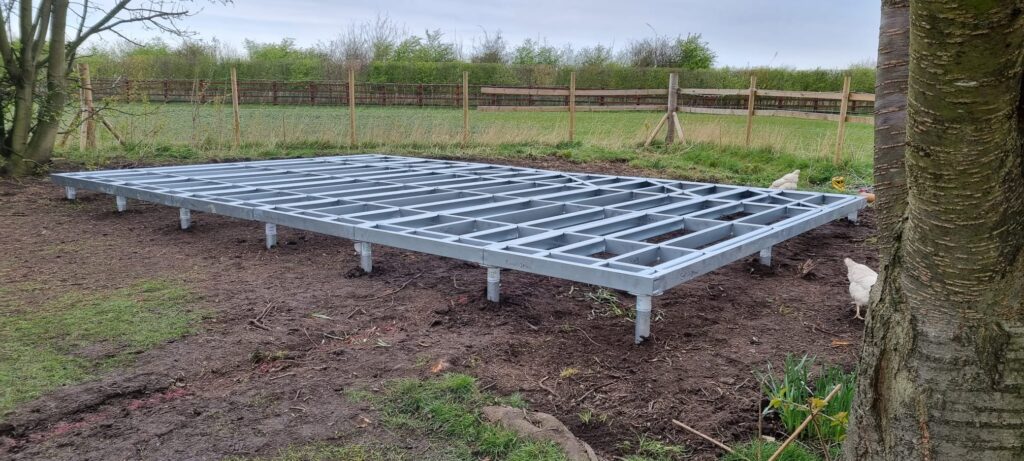
Lodge sites are rarely built on a classic construction site. You’re often working with sloped fields, narrow access lanes, and sensitive environmental challenges. Here are some of the specific difficulties concrete presents for holiday lodge construction:
- Access constraints: Concrete lorries need solid ground and a reasonable width to manoeuvre. Sites beyond single-track lanes, across soft ground, or up steep gradients require specialist pumping equipment, multiple smaller loads, or wheelbarrow runs – all of which add substantial cost and time.
- Excavation damage and waste: Digging foundation trenches means moving significant soil volumes, requiring skip hire and disposal. On sites with Tree Preservation Orders (TPOs) or near protected features, excavation can breach planning conditions entirely.
- Drainage disruption: The excavation process disrupts natural drainage patterns and potentially damages tree roots, creating long-term problems beyond the foundation work itself.
- Chemical leaching: Fresh concrete is highly alkaline (pH 12-13) and leaches into the surrounding soil over time, harming acid-loving plants.
- Weather dependency: Concrete needs dry conditions and temperatures above 5°C to cure correctly. Rain, frost, or cold weather can significantly extend timelines, potentially causing lodge operators to miss prime booking periods.
- Permanence of mistakes: Once concrete sets, there’s no going back. Uneven foundations cause doors to stick, windows to bind, and structural issues that are expensive and disruptive to correct.
We should also mention that concrete may simply not be permitted on some natural sites.
For example, Conservation Areas impose stricter planning controls where preserving or enhancing character takes priority. Many lodge sites occupy or adjoin these protected zones, where concrete foundations often require planning permission that wouldn’t be needed elsewhere.
Additionally, local planning authorities can issue Article 4 Directions removing permitted development rights (PDRs), thus requiring formal applications. The key issue with concrete is that it constitutes a permanent site alteration that can cause environmental damage, depending on the site, access, and other factors.

What Ground Screws Deliver for Lodge Foundations
Ground screws work like oversized corkscrews, twisting into the ground to create individual foundation points. The helical plates along each screw cut through different soil layers whilst compacting the surrounding ground, creating anchor points that resist both weight and lateral wind forces.
The form, function, and versatility of ground screws bring several practical benefits to the table:
- No excavation required: Screws displace soil rather than removing it, so there are no skips, no mountains of spoil, and no damage to surrounding ground or tree roots.
- Immediate load-bearing capacity: Unlike concrete, which needs days or weeks to cure, ground screws carry their full structural load as soon as installation completes.
- Adaptation to sloped ground: Each screw can be driven to different depths whilst the tops remain level, creating a flat platform without extensive earthworks.
- Environmental compliance: Minimal disturbance makes ground screws suitable for sites with Tree Preservation Orders, proximity to waterways, or sensitive habitats.
- Complete removability: If you need to relocate a lodge or adjust your site layout, ground screws can be extracted entirely without leaving permanent damage.
We’ve demonstrated these benefits across our many case studies, from installing a footbridge foundation for Powys County Council in Wales on challenging terrain to a school boardwalk in Leicestershire that protected established trees whilst providing essential access.
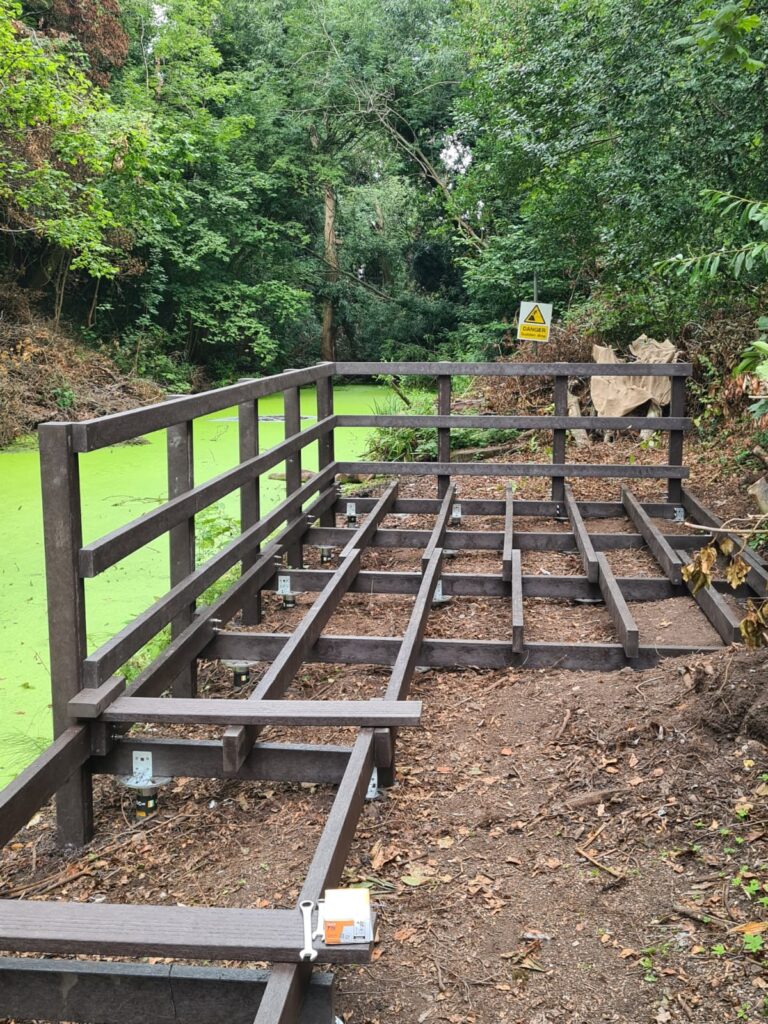
At the RHS Malvern Spring Festival, we installed exhibition structure foundations that were removed entirely post-event, restoring the site to its original condition.
Ground Screws for Different Types of Holiday Accommodation
Ground screws are suitable for the full spectrum of holiday accommodation. Here’s how they perform for specific applications:
Static Caravans and Mobile Homes
Static caravans need stable, level chassis support to prevent structural damage. Adjustable ground screws allow fine-tuning on sloped or variable ground, preventing the chassis distortion that causes cracked panels, sticking doors, and failed seals.
Timber Lodges and Garden Rooms
Timber lodges require solid mounting points at multiple load-bearing positions. Ground screws deliver this without excavation mess or concrete delays. For larger lodges spanning 8-10 metres, adjustable brackets correct any installation discrepancies to achieve perfect levels – precision that’s difficult with concrete.
Glamping Pods and Shepherd’s Huts
Glamping sites are often located in sensitive areas that aren’t suited to concrete. Ground screws provide robust foundations without excavation or permanent site alteration, and they sit beneath frames where they’re not visible – maintaining the natural aesthetic guests expect.
Moreover, installation is rapid – whether it’s a bright summer day or the middle of winter – valuable for working around seasonal bookings.
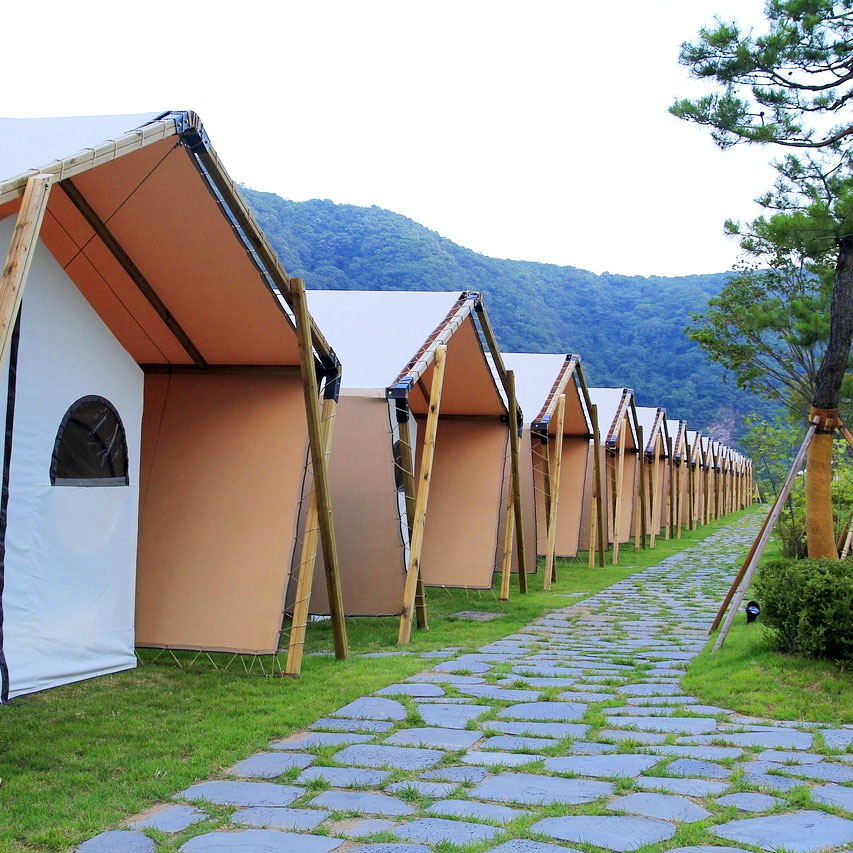
Safari Tents and Canvas Structures
Canvas structures need durable, wind-resistant anchoring without the engineering required for solid lodges.
Ground screws provide excellent support while remaining fully removable for semi-permanent installations. Install in spring, remove in autumn, leaving no trace during winter months when planning conditions may require site restoration.
Installation Considerations for Holiday Lodge Projects
Holiday lodges vary enormously in weight – lightweight glamping pods might weigh under a tonne, while fully equipped timber lodges can exceed 10 tonnes. Ground screw specifications must match these loads precisely.
Our team calculates the required screw length, diameter, and spacing based on your lodge and ground conditions. Key factors include:
- Structural load distribution: Weight concentrations at specific support points
- Ground composition: Clay, sand, rock, or mixed soil types affecting screw depth – read our guide on ground conditions here
- Seasonal ground movement: Water table variations and frost heave potential
- Wind exposure: Additional lateral forces on exposed or elevated sites
For larger or commercial installations, we provide load testing to verify performance before the lodge arrives on site, giving you certified documentation for compliance purposes.
Site Challenges and Installation Logistics
Ground screws are installed using equipment that fits in a standard van, allowing our teams to work on sites accessible only by farm track or across soft ground. Light equipment doesn’t compact soil or damage surfaces.
For sites with slopes, ground screws preserve natural character and drainage patterns whilst providing solid foundations. Read our guide to installing ground screws on slopes for detailed information on challenging terrain.
Professional Installation vs Self-Installation Options
Smaller glamping pods and shepherd’s huts can work with our self-install ground screw range, particularly on straightforward sites with level ground.
However, most holiday lodges benefit from professional installation to ensure strong, compliant foundations that are designed to handle the weight of larger structures.
Start Your Holiday Lodge Project
Ground screws suit holiday lodge foundations across all accommodation types, from compact glamping pods through to substantial timber lodges. They eliminate the excavation, concrete mess, and extended timescales that make traditional foundations problematic on rural sites.
The combination of rapid installation, site flexibility, and robust long-term performance makes ground screws particularly valuable for lodge operators working under tight deadlines or facing challenging site conditions.
Ready to kick off your project? Use our ground screw calculator to work out what you’ll need, browse our complete range of screws and brackets, or contact our team for specific advice on your lodge foundations.