


How the two leading foundation choices compare
For decades, concrete was the default choice for foundations, but more and more homeowners are choosing ground screws instead.
Both options can give you a solid, long-lasting base, so which one should you pick? The answer depends on what you’re building, the ground in your garden, your budget, and even the time of year.
Let’s compare ground screws and concrete across the key factors that matter to your project.
In the simplest terms, concrete spreads the weight of your building across a solid slab or set of pads at the surface, while ground screws anchor into the soil at a series of fixed points.
The goal in the end is the same: to provide a base to build on, whether that’s a shed or a larger building.
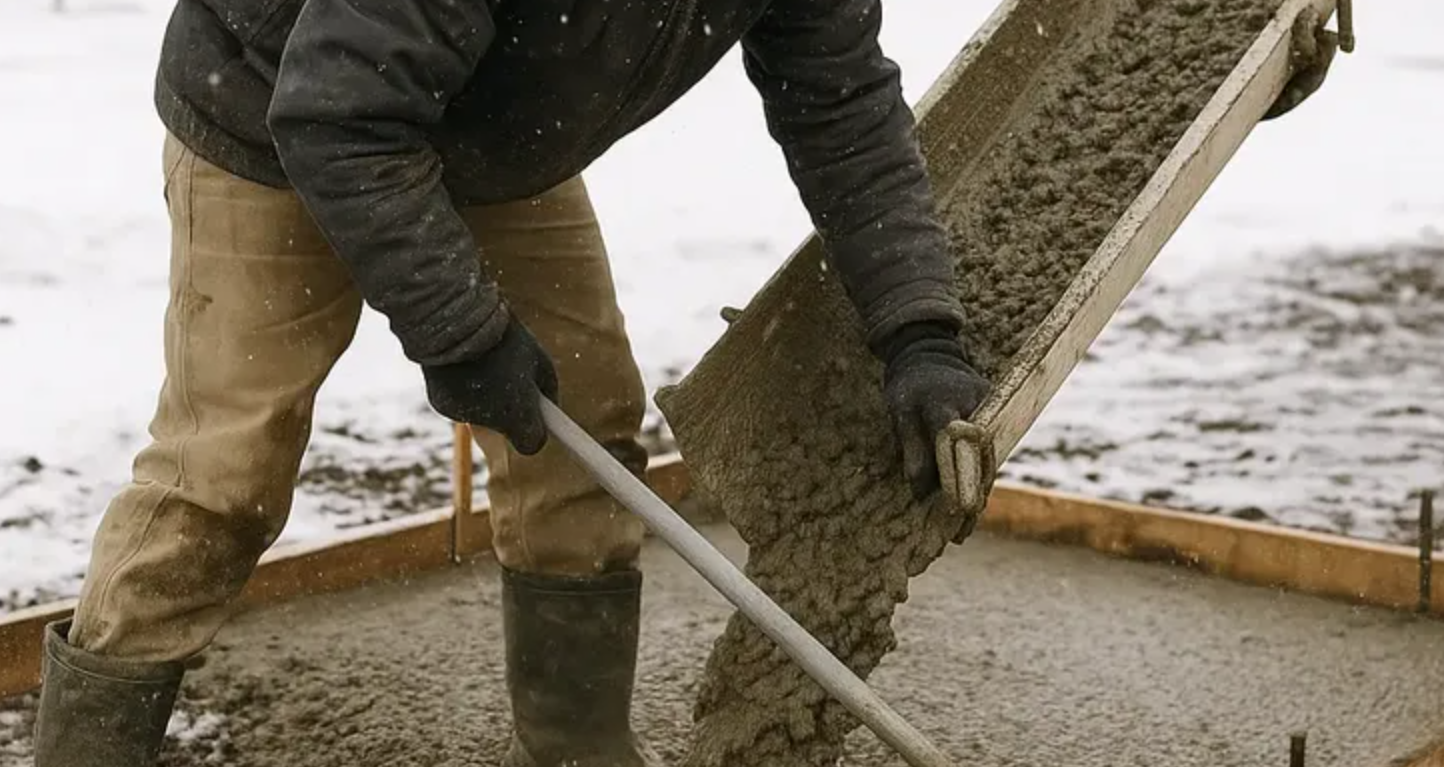
For a classic concrete base or strip footing, you dig out the area, lay down a layer of compacted hardcore and a damp-proof membrane, then build timber shuttering around the edges to hold the concrete while you pour it.
Concrete hardens through a chemical reaction between the cement and water in the mix, which takes time (though it depends on the concrete and conditions). The finished slab gives you a solid, flat surface to build on.
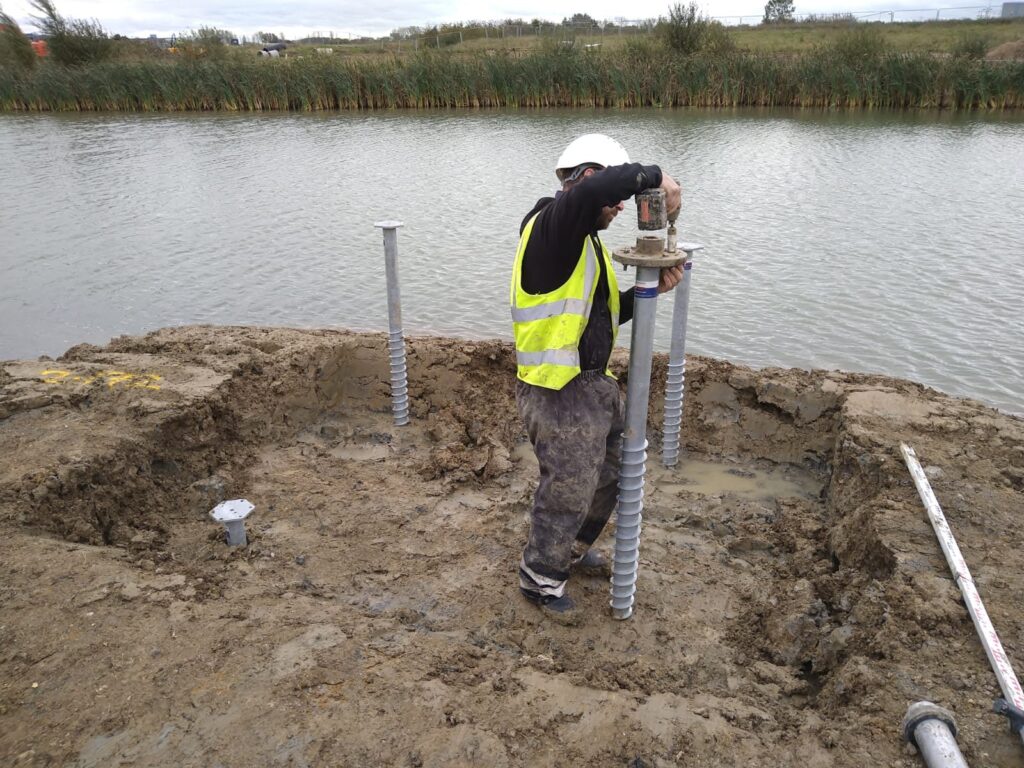
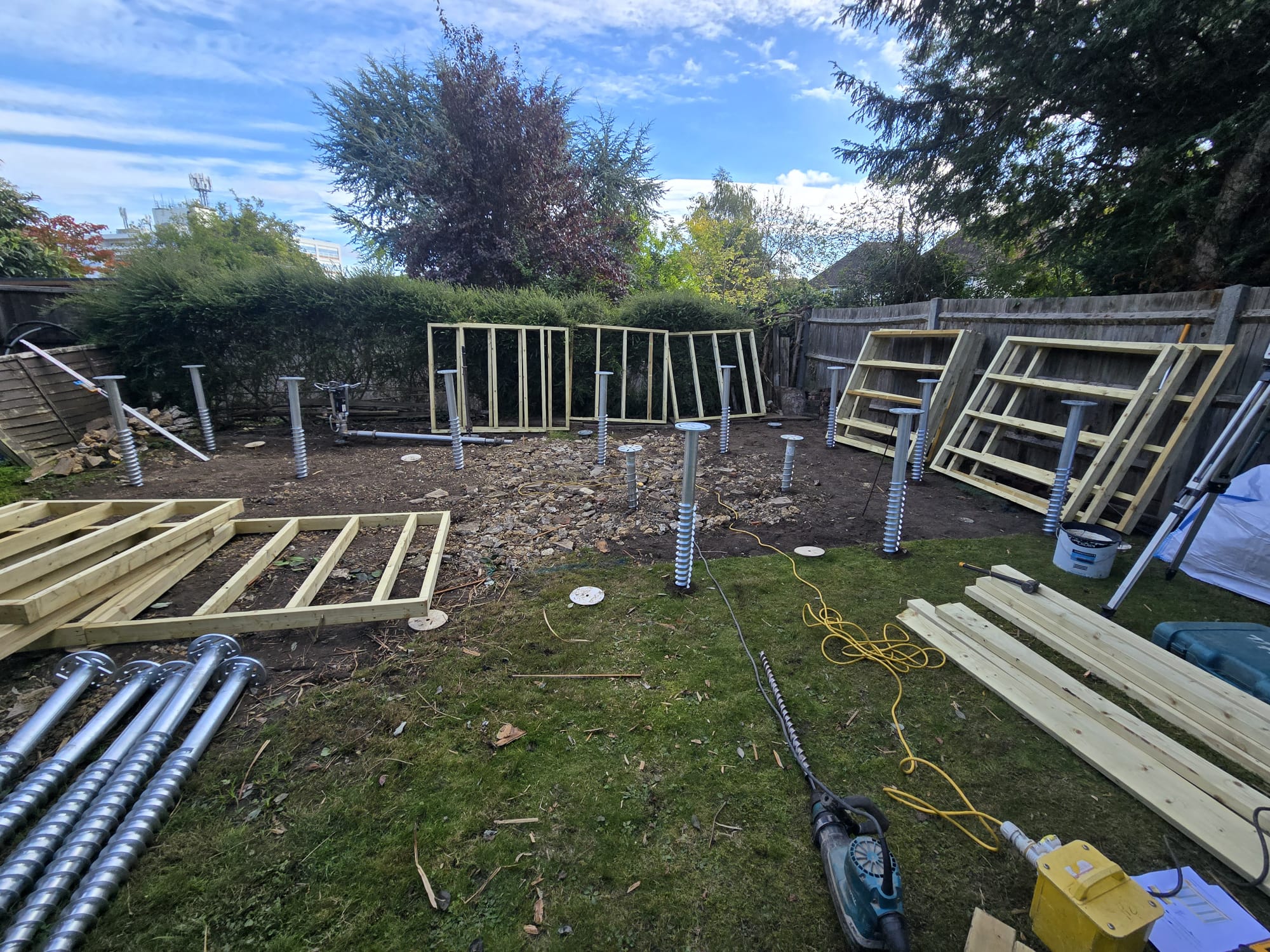
A ground screw is a steel shaft with helical blades welded to its lower section. You rotate it into the ground, either by hand with a ratchet tool or with a lightweight machine driver.
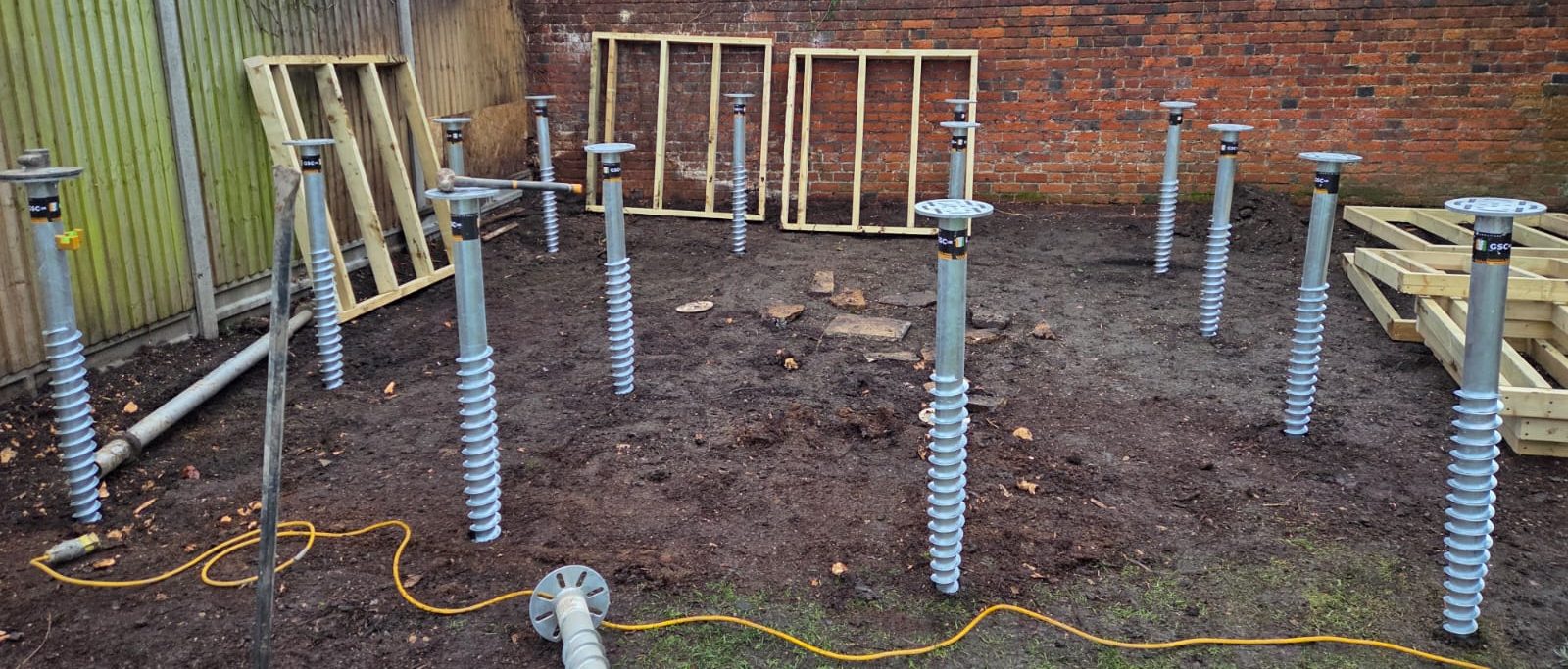
As the screw turns into the soil, the blades interlock with the soil and compact it around the shaft. That creates a dense, stable anchor point that resists both downward pressure and sideways forces. Each screw stops with its top just above ground level, ready for a bracket that connects to your timber frame, joists or posts.
Rather than one large slab, a grid of ground screws supports your building, with each one carrying its share of the load.
The table below sums the key differences between concrete and ground screws:
| Ground screws | Concrete | |
| Excavation | None | Dig out the full base or pad holes |
| Waste | No spoil and no skips | Spoil to remove, usually by skip |
| Ready to build on | Straight away | After the concrete has cured |
| Cold weather | Install year-round, including in frost | Curing slows below 5°C, and frost can damage fresh concrete |
| Sloping ground | Set each screw to the height you need | Extra digging, stepped footings or building up the low side |
| Access | Screws, brackets and tools carried by hand | Room for a digger, mixer or ready-mix delivery |
| Tree roots | Position screws to avoid roots | Digging can damage roots |
| Removal | Unscrew and reuse | Break out and dispose of |
When you price up concrete foundations, the concrete itself is only part of the bill. A typical small base can also involve:
A ground screw foundation cuts most of that out, which is the key cost advantage.
You pay for the screws and brackets, plus labour for a single visit if you’d rather not install them yourself.
Our price comparisons estimate ground screws are up to 37% cheaper than concrete for trade projects, and rising concrete costs have only widened the gap.
Concrete foundations can turn a garden into a building site for days. Ground screws are a far cleaner way to build, with no excavation. Those same benefits also make ground screws more sustainable.
Self-installation is also well within reach for a confident DIYer. You mark out the positions, install the ground screws with a ratchet tool, then fit and level the brackets ready for your frame.
If you’d rather leave it to the experts, we perform professional installation across the UK all year-round.
Winter poses numerous issues for concrete. If water in fresh concrete freezes before it gains enough strength, it expands and can damage the base from the inside.
Builders can pour concrete in cold weather, but it takes extra work and expense. Depending on the conditions, that can mean protecting the ground from frost before the pour, covering the fresh concrete with thermal blankets and monitoring its temperature.
Rapid-setting concrete does help, but comes with its own drawbacks.
Ground screw installation is purely mechanical. In fact, firm frozen ground can make positioning and levelling easier. All in all, you can install ground screws in winter just as you would in summer.
Very few gardens are perfectly flat and easy to reach – so what do you do if you encounter trees, slopes, or tight access?
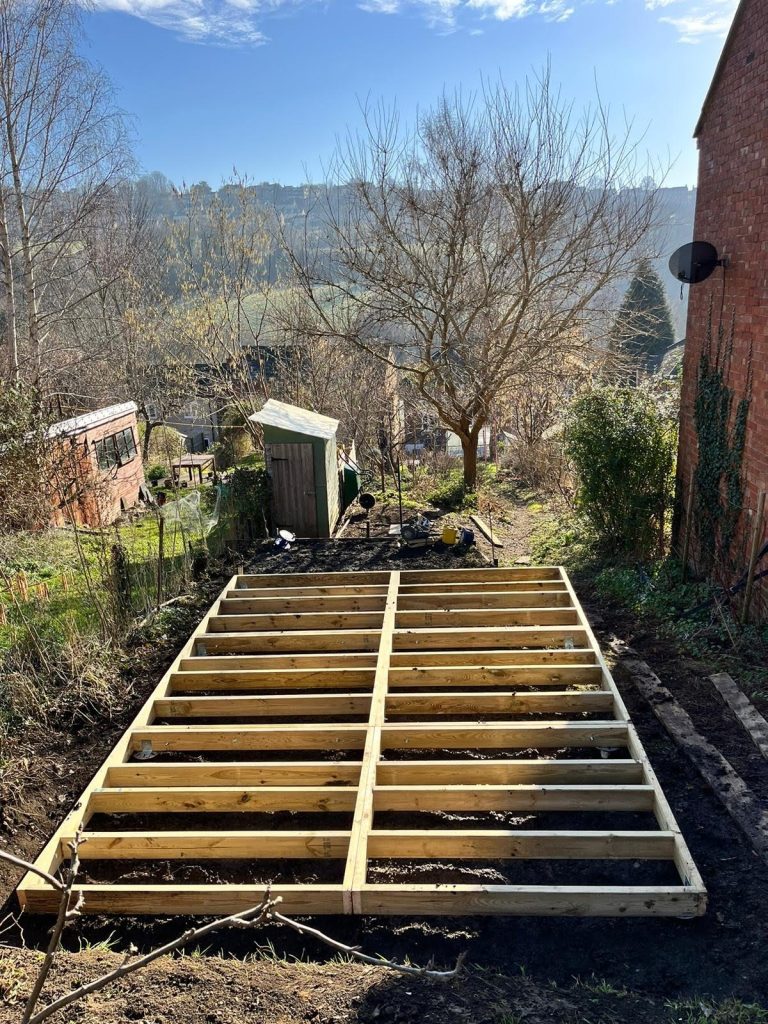
On sloping ground, concrete means digging into the high side or building up the low side, often with stepped footings. With ground screws, you simply install them to the height you need, and adjustable brackets let you fine-tune the level afterwards.
Trees are another common issue. Digging a trench or slab near a mature tree can damage its roots, and if the tree has a Tree Preservation Order, you may not be allowed to dig at all.
Because each ground screw needs only a small footprint, you can position them around the roots.
Tight access is rarely an issue, either. Our screws, brackets and installation tools can all be carried by hand, so a narrow side passage or a garden behind a terraced house isn’t a problem.
Ground screws suit most soil types as well, although the type of soil in your garden can affect which length of screw you need.
If you want a solid concrete floor – for a garage you’ll park a car in, a hardstanding or a patio, for example – a slab is usually the right choice.
For larger or heavier structures, such as an extension that needs building control approval, the foundation design will depend on the loads and the ground, and your engineer or building control officer will advise accordingly.
Ground screws are often suitable for these projects too, and site-specific load testing gives building control the evidence it needs.
For the heaviest loads, helical screw piles offer a machine-installed alternative to deep concrete foundations.
Our ground screws are CE approved and come with a 20-year product guarantee. We hold one of the UK’s largest ranges in stock, with next-working-day delivery available, so your project can start as soon as you’re ready.
Not sure which ground screw size you need? Our team is always happy to help.
If you’d like to see how ground screws perform in your own garden before you commit, our trial kit includes a ground screw, a bracket and a rental ratchet tool, and you can return it for a full refund if ground screws aren’t right for your project.
Ready to start your project? Browse our range of ground screws, or contact us and we’ll help you find the right foundation.